WILLEMSTAD – 9 December 2025 – The Global Coral Reef Monitoring Network (GCRMN) today publishes its latest report detailing the “health” of coral reefs in the Caribbean region. The report compiles 23,742 surveys conducted by around 200 scientists, aiming to provide an overview of how Caribbean reefs have changed over the past five decades. The findings are co-published by the United Nations and are intended primarily for policymakers responsible for coral reef management.
However, the report is not without controversy. When assessing changes in coral cover across 44 Caribbean countries, the authors used a mathematical model that generated estimates for locations where no surveys had been conducted. “In principle, such a model can be useful, but in this case the estimates it produced for locations where we do know the actual coral cover (such as Curaçao) differed enormously from the measured values,” says Mark Vermeij of CARMABI, who contributed to the report for a year but recently withdrew due to the many errors he and other scientists discovered. “The overall message remains the same: coral cover in the Caribbean is declining rapidly. But some islands are now being assigned far more or far less coral than they actually have because of the model used by GCRMN. We communicated these observations to GCRMN, but nothing was done with them.”
The model also suggests that storms such as Tropical Depression Felix in 2008 and Isidore in 2004 caused major damage to Curaçao’s reefs, while in reality no such damage occurred. “I actually had to look up which storms those were, because I had never heard of them. Storms that did cause damage, like Lenny and Omar, are not mentioned anywhere in the report,” Vermeij adds. “According to the GCRMN report, Curaçao’s coral reefs cover an area of 103 square kilometers. The island has almost no reefs on its northern coast, and considering the island is about 70 kilometers long, this would mean the reefs along the southern coast extend more than a kilometer offshore. Everyone knows that’s not the case. It’s unfortunate that GCRMN places more trust in a model than in what we actually know and measure on the islands themselves.”
The causes of reef decline remain the same as in previous GCRMN reports: pollution, coastal development, overfishing, climate change, overtourism, diseases, and more. The average percentage of seafloor covered by coral was 28 percent in 1985, dropping to 15 percent in 2024 according to the report. In 1970, coral cover still ranged between 40 and 50 percent. Curaçao follows this general pattern, but Vermeij notes that averages obscure local exceptions: “There are still reefs around Curaçao that rank among the Caribbean’s best, as was also clearly stated in the previous 2013 GCRMN report.”
“The reefs at Oostpunt, Klein Curaçao and Kaap Marie are still among the strongest in the region, although coral diseases and bleaching are visible there as well. These relatively ‘healthy’ reefs recover far better from such stressors than many reefs elsewhere on the island,” says Manfred van Veghel, CARMABI’s director.
CARMABI considers the latest GCRMN report a missed opportunity to clearly present the status of the region’s reefs in one place. “We are now working on our own updated report on the state of Curaçao’s reefs, which includes far more detail than the GCRMN report. We hope to share it soon so that stakeholders can stay informed about the threats to our reefs, as well as the unique reef systems that still exist around the island,” Vermeij concludes.
Link to the report: https://gcrmn.net/caribbean-report-2025-v1/
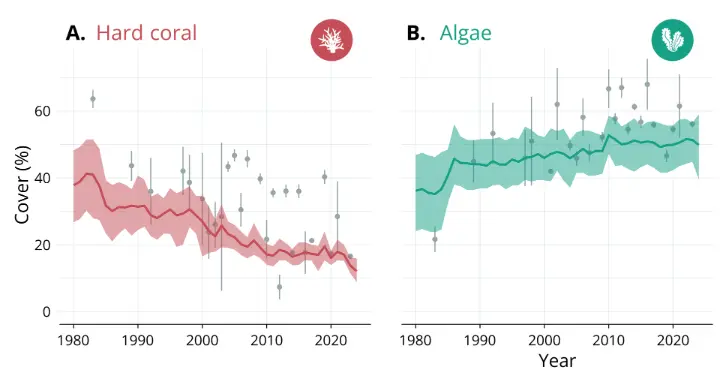
Figure 1: For Bonaire, the model results are not much better than for Curaçao. The colored bands show the model’s predictions, while the points represent actual measurements of coral and algae around the island.
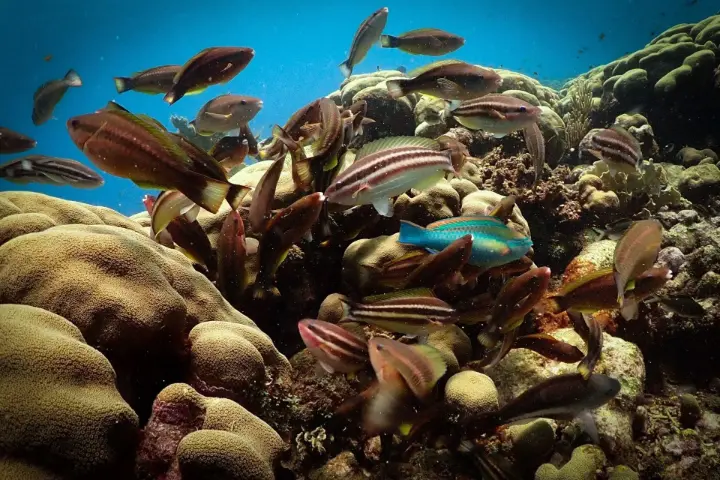
Figure 2: Protecting herbivorous fish species such as parrotfish is recommended in the GCRMN report as one of the most important measures islands can take to combat reef decline. Vermeij and Van Veghel of CARMABI support this message and point to numerous examples elsewhere showing that this measure indeed leads to healthier coral reefs.
Press Release – Report on the Status of Caribbean Reefs (1970–2024) Published